
US taxes for expats in 2026: Guide for American expats

Moving abroad usually brings unexpected situations and a lot of figuring things out. One thing that American expats can expect NOT to change is their tax obligations. If you’re a US citizen living abroad, taxes are still part of the picture. The IRS still expects to hear from you.
IRS Publication 541, the Tax Guide for US Citizens and Resident Aliens Abroad, makes this clear: US citizens and resident aliens owe tax on their worldwide income no matter where they live2, and they're required to report it. Unlike most countries, which tax people based on where they live, the US taxes based on citizenship instead, even if they live abroad. This blindsides many Americans who move overseas expecting a clean break.
This guide walks through who needs to file, what you might owe, and how to handle US taxes for expats without losing a weekend to paperwork. We'll cover US expat tax basics, the exclusions that can bring your bill to zero, and the reporting rules that catch many people by surprise. Think of it as the guide you wish someone had handed you before you packed your bags.
Who has to file US taxes while living abroad?
Three groups are generally required to file US taxes while living abroad: US citizens, green card holders, and resident aliens. If you hold a US passport, you’re typically subject to US tax filing requirements no matter where you live. Green card holders follow the same rules until they formally give up that status, even if they left the US a decade ago and never plan to go back. Resident aliens, meaning non-citizens who meet the green card test or the substantial presence test, fall under the same rules.4
Filing comes down to your income and filing status. For the 2025 tax year (the return most US citizens living abroad are filing in 2026), here's when you're required to file as per IRS Publication 5015:
|
Filing status |
2025 filing threshold |
|---|---|
|
Single, under 65 |
$15,750 |
|
Single, 65 or older |
$17,750 |
|
Married filing jointly, both under 65 |
$31,500 |
|
Married filing jointly, one 65 or older |
$33,100 |
|
Married filing jointly, both 65 or older |
$34,700 |
|
Head of household, under 65 |
$23,625 |
|
Head of household, 65 or older |
$25,625 |
|
Married filing separately |
$5 |
|
Self-employed |
$400 in net earnings |
That $5 filing threshold for married taxpayers filing separately is easy to overlook. If you married someone who isn't a US taxpayer and you file separately, you may be required to file a return even if you earned very little income.
Do you have to pay US taxes if you live abroad?
Not always. Filing a return and owing money are two different things, and confusing the two is where a lot of the dread around US expat taxes comes from.
Here's vital information: you can only claim these benefits by filing. If you don’t file because you assume you don’t owe any tax, you may miss out on these valuable tax benefits. Publication 54 states that eligible Americans abroad qualify for the Foreign Earned Income Exclusion and Foreign Tax Credit, but they can only get them by filing a return.1
Why do Americans living abroad still file US taxes?
The US uses a system called citizenship-based taxation. Most other countries base tax obligations on residency, so people who leave typically stop being subject to that country's tax system once they've settled somewhere else8. The US continues to tax its citizens regardless of where they moved.
That difference is backed by law and by a century-old Supreme Court ruling. The Sixteenth Amendment9 gives Congress the power to tax incomes “from whatever source derived,” without exempting income earned outside the country. In 192410, a US citizen living in Mexico argued he shouldn't owe US tax on income from property he owned there. The Supreme Court disagreed. In Cook v. Tait, the Court held that Congress has the power to tax the income a US citizen receives even when that citizen is domiciled abroad and the income comes from property located outside the country.
Foreign Earned Income Exclusion (FEIE)
The FEIE lets you reduce or eliminate US tax on a portion of what you earn abroad11, up to $130,000 (2025 tax year) and $132,900 (2026 tax year). If you’re married and both of you work overseas, you can each claim it separately, effectively doubling the amount your household can exclude.12
It's available to US citizens and resident aliens who have a tax home in a foreign country and who earn income from personal services performed there. Here are a few things to know before claiming it:
- Only earned income qualifies: wages, salaries, self-employment income6
- Dividends, rental income, and capital gains don't qualify, no matter where they're generated
- You claim it by filing Form 2555 with your regular return
- You must meet one of two tests to claim it13
The physical presence test is straightforward and simply requires counting the days you spend abroad. You need 330 full days in a foreign country or countries during any 12-month period. “Full” means a full 24-hour stretch, midnight to midnight, so a flight that touches down in the US partway through a travel day can prevent that day from counting toward the 330-day requirement.14
The bona fide residence test works differently. Instead of counting days, the IRS looks at whether you've genuinely made a foreign country your home for an entire uninterrupted tax year, based on evidence like15:
- Local ties and community involvement
- A lease or property ownership
- Registration with local tax authorities13
You just have to prove you actually live there16, not that you're passing through on an extended visa run. Take a US citizen teaching English in South Korea who earns $70,000 a year and has no other income. Meeting either test lets that person exclude their whole salary, so they wouldn’t owe US federal income tax on that income. That's common for expats in lower-tax or no-tax countries: the FEIE alone may eliminate their US federal income tax liability.
Foreign Tax Credit (FTC)
The Foreign Tax Credit gives you a dollar-for-dollar reduction in US tax for income tax you've already paid to a foreign government17. You claim it on Form 111618. Unlike the FEIE, it isn't limited to earned income. Dividends, interest, and other foreign-source income can qualify, too, as long as the tax was actually imposed on you and you were legally liable to pay it.
One catch is that you can't apply the FTC to income you've already excluded under the FEIE19. You can’t claim both benefits on the same income.
Which one saves you more comes down to where you live:
|
Your situation |
Likely better fit |
Why |
|---|---|---|
|
Low-tax or no-tax country, income under $130,000 |
FEIE |
Excludes the income outright |
|
High-tax country where local rates exceed US rates |
FTC |
Local tax paid often erases the entire US bill |
|
Income above the FEIE cap |
FEIE + FTC |
FEIE on the first portion, FTC on the rest |
|
Investment income like dividends or interest |
FTC |
FEIE doesn't cover passive income |
FBAR and FATCA: Reporting foreign bank accounts
Two separate reporting rules apply once you're banking abroad. They’re designed to give the US government visibility into foreign accounts.
FBAR is short for Report of Foreign Bank and Financial Accounts. You’ll need to file an FBAR if the combined value across all your foreign accounts exceeds $10,000 at any point during the calendar year20. You don't attach it to your tax return. It goes straight to FinCEN through the BSA E-Filing System. April 15 is the deadline, though there's an automatic extension to October 15 if you miss it.21
FATCA works differently. Instead of one flat threshold, the reporting thresholds depend on your filing status and where you live:
|
Filing status, living abroad |
Threshold (last day of year) |
Threshold (any time during the year) |
|---|---|---|
|
Single or married filing separately |
$200,000 |
$300,000 |
|
Married filing jointly22 |
$400,000 |
$600,000 |
FATCA is reported on Form 8938, which you can attach to your Form 1040. Unlike the FBAR, there’s no separate filing with FinCEN required.23
People often don’t realize which assets count toward these thresholds. Checking and savings accounts count. So do brokerage accounts, foreign pensions, and mutual funds24. Say you've got $4,000 sitting in one account and $7,000 in another. Neither exceeds the $10,000 FBAR threshold on its own, but together they do, triggering an FBAR filing requirement.
None of this means you're under suspicion. Millions of Americans25 abroad file both forms every year as routine paperwork. The penalties exist for people who don't report, not for having money in a foreign bank.
How to file US taxes from abroad
The process of filing US taxes from abroad is largely the same as filing domestically. The details just shift a little at each step.
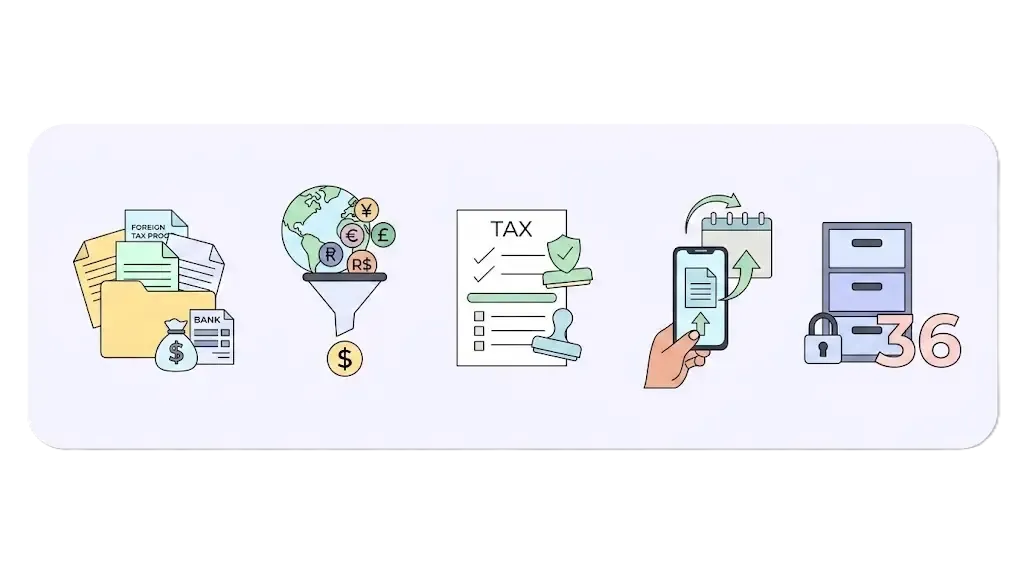
- Collect your documents. Most foreign employers don't issue a W-226, so start with whatever income statement or final pay summary your employer does provide. Add proof of any foreign tax27 you paid since that documentation is what supports a Foreign Tax Credit claim later. If you have foreign bank or investment accounts, pull statements for those, too. They’ll help you determine whether you need to file an FBAR or Form 8938 for FATCA.
- Report your foreign income. Every dollar goes on the return, converted to US dollars, even the portion you plan to exclude later. The IRS wants your full worldwide income reported first. Exclusions and credits get applied afterward.28
- Claim your exclusions and credits. This is where Form 2555 (FEIE) or Form 1116 (FTC) come in. Pick whichever fits your situation, or use both if part of your income falls under the FEIE cap and the rest doesn't.
- Submit your return. Taxpayers with a foreign address can e-file their returns4. The IRS says so directly, and e-filing is generally faster and more reliable than mailing a paper return internationally. If you're living abroad on the regular due date, you get an automatic two-month extension to June 15. That extension covers filing only. Interest on any unpaid balance still starts accruing on April 15.4
- Keep your records. The IRS generally recommends holding onto records for three years from when you file since that's the standard audit window. If you underreport income by more than 25% of what's on your return, that window stretches to six years. If you never file at all, there's no time limit on how far back the IRS can look.29
That's how to file US taxes from abroad, start to finish: gather, report, claim, submit, keep.
Common mistakes US expats make
Most of the trouble people run into with expat tax filing isn't complicated tax strategy gone wrong. It's a handful of assumptions that turn out to be false.
Some assume that once they've been gone a few years, the IRS loses interest. It doesn't, and skipping a return doesn't make the obligation go away. The failure-to-file penalty30 is 5% of unpaid tax per month, capped at 25%.
Paying tax to your host country doesn't cancel the US filing requirement. The two obligations run in parallel, and the FTC helps reduce or eliminate double taxation rather than replace one with the other.
This one can result in significant financial penalties. A non-willful FBAR violation can run up to $16,536 per unfiled report31, adjusted for inflation.
This mistake costs money rather than triggering a penalty directly. Expats who don't realize the exclusion is available sometimes pay US tax on income that could've been sheltered entirely. And it's not automatic. You have to file Form 2555 to claim it. Skip filing it for one year, and the IRS treats that as revoking the choice, which locks you out of claiming it again for five tax years unless the IRS approves an exception.32
Every one of these traces back to the same root: treating expat tax return obligations as something that fades with distance. It doesn't. The paperwork is manageable once you know what's actually required.
How international money transfers fit into life abroad
Taxes are only one part of managing your finances across two countries. Once you're filing from abroad, you're usually also moving money in both directions: paying the IRS from a foreign bank account, receiving a refund back to that same account, or sending money home to cover a mortgage or family expenses while you're earning in another currency entirely.
The IRS itself doesn't make the payment process particularly simple. Refunds can only be direct deposited into a US bank account33, and IRS Direct Pay requires a US routing number34. The IRS does offer its own international wire option for paying from a foreign bank account, but it comes with its own paperwork and, by the IRS's own admission, can be costly compared to other payment methods.35
Then there's money flowing the other way. Plenty of expats send money home to support family, pay off a US-based loan, or move savings between accounts in two countries. Every transfer means weighing exchange rates and fees, and those trade-offs don't disappear just because tax season is over.
Knowing your filing obligations is only one side of the equation. For anyone juggling US taxes alongside daily life in another country, having a straightforward way to move money between currencies is another practical concern worth considering alongside the FEIE and FTC calculations.
Do expats pay US taxes?
Not always, but they usually have to file. Filing is required once you cross the income thresholds, and tools like the FEIE and FTC often bring the actual bill to $0, provided you claim them.
Do I file taxes if I already pay taxes overseas?
Yes. Foreign tax paid can reduce or eliminate what you owe through the FTC, but it doesn't cancel the US filing requirement itself.
What happens if I don't file US taxes?
The failure-to-file penalty is 5% of unpaid tax per month, capped at 25%, plus interest from the original due date. If you're owed a refund, there's no penalty, but it must be claimed within three years, or it's forfeited.36
Can I file US taxes online?
Yes. Returns with a foreign address can be e-filed, which is generally faster and more reliable than mailing internationally.
When is the deadline?
April 15, with an automatic two-month extension to June 15 for anyone abroad. That extension covers filing only. Interest still accrues from April 15 on anything owed.
Do green card holders file taxes abroad?
Yes, until they formally give up that status, even after years of living outside the US.
Sources: all third party information obtained from applicable website as of August 10, 2026
- https://www.irs.gov/publications/p54
- https://www.greenbacktaxservices.com/knowledge-center/difference-residency-based-taxation-citizenship-based-taxation/
- https://www.irs.gov/newsroom/national-taxpayer-advocate-delivers-annual-report-to-congress-finds-taxpayer-service-was-strong-in-2025-but-foresees-challenges-for-taxpayers-who-encounter-problems-in-2026
- https://www.irs.gov/individuals/international-taxpayers/us-citizens-and-resident-aliens-abroad
- https://www.irs.gov/publications/p501
- https://www.irs.gov/individuals/international-taxpayers/foreign-earned-income-exclusion
- https://www.irs.gov/individuals/international-taxpayers/foreign-tax-credit
- https://www.acaglobalfoundation.org/rbt
- https://www.archives.gov/founding-docs/amendments-11-27
- https://supreme.justia.com/cases/federal/us/265/47/
- https://www.investopedia.com/terms/f/foreign-earned-income-exclusion.asp
- https://www.irs.gov/individuals/international-taxpayers/figuring-the-foreign-earned-income-exclusion
- https://www.taxesforexpats.com/articles/tax-saving-strategies/foreign-earned-income-exclusion.html
- https://www.irs.gov/individuals/international-taxpayers/foreign-earned-income-exclusion-physical-presence-test
- https://www.irs.gov/instructions/i2555
- https://www.irs.gov/individuals/international-taxpayers/foreign-earned-income-exclusion-bona-fide-residence-test
- https://brighttax.com/blog/foreign-tax-credit-calculation/
- https://www.irs.gov/forms-pubs/about-form-1116
- https://www.irs.gov/individuals/international-taxpayers/foreign-taxes-that-qualify-for-the-foreign-tax-credit
- https://www.greenbacktaxservices.com/knowledge-center/fbar/
- https://www.irs.gov/businesses/small-businesses-self-employed/report-of-foreign-bank-and-financial-accounts-fbar
- https://www.irs.gov/businesses/corporations/summary-of-fatca-reporting-for-us-taxpayers
- https://www.irs.gov/businesses/corporations/fatca-information-for-individuals
- https://brighttax.com/blog/fatca-everything-expats-need-know/
- https://www.greenbacktaxservices.com/knowledge-center/fbar-vs-8938/
- https://scltaxlaw.com/filing-us-taxes-foreign-employer-no-w2/
- https://www.irs.gov/publications/p514
- https://www.taxesforexpats.com/articles/expat-tax-rules/us-expat-taxes.html
- https://www.irs.gov/businesses/small-businesses-self-employed/how-long-should-i-keep-records
- https://www.irs.gov/payments/failure-to-file-penalty
- https://www.federalregister.gov/documents/2025/01/17/2025-01374/financial-crimes-enforcement-network-inflation-adjustment-of-civil-monetary-penalties
- https://onlinetaxman.com/feie-vs-foreign-tax-credit
- https://www.irs.gov/refunds/get-your-refund-faster-tell-irs-to-direct-deposit-your-refund-to-one-two-or-three-accounts
- https://www.irs.gov/payments/direct-pay-help
- https://www.irs.gov/individuals/international-taxpayers/foreign-electronic-payments-tax-type-codes
- https://turbotax.intuit.com/tax-tips/tax-refund/last-chance-to-claim-your-tax-refund/L1ySMyA2H
This article is provided for general information purposes only and is not intended to address every aspect of the matters discussed herein. The information in this article is not intended as specific personal advice. The information in this article does not constitute legal, tax, regulatory or other professional advice from IDT Payment Services, Inc. and its affiliates (collectively, “IDT”), and should not be taken or used as such by any individual. IDT makes no representation, warranty or guaranty, whether express or implied, that the content in this article is current, accurate, or complete. You should obtain professional or other substantive advice before taking, or refraining from, any action on the basis of the information in this article.
