
Best way to send money to Philippines 2026: Providers & Fees

Anyone who sends money to the Philippines more than once figures this out pretty quickly. The fee you see at the start is not the real cost. It looks simple, but the number that actually matters is how much ends up in PHP on the other side.
A lot of services still advertise low or zero fees. That pulls people in. Then the exchange rate does the rest. You might not notice it on a small transfer, but once the amount goes up, the difference becomes obvious.
That is why people rarely rely on a single app anymore. They check two or three before sending. It is not overthinking it. It is just the easiest way to avoid losing money quietly.
The best way to send money to Philippines depends on what you care about in that moment. Is the cost more important to you, speed, or convenience? You usually have to give up one to get more of the other. Always remember: the cheapest way to send money to Philippines or elsewhere is not always the fastest, and the fastest way to send money to Philippines or elsewhere is rarely the cheapest.
What makes a money transfer to the Philippines “cheap”?
People tend to look at the fee first. That is normal. It is the only number that is clearly shown. But the fee is only one part of it.
It sounds small, but it adds up. A service with a $0 fee may still be more expensive because of the exchange rate. Then there is how the money is delivered. Bank deposits are often cheaper than cash pickup. Wallet transfers can be somewhere in between. It depends on the provider and the route.
The payment method matters too. If you use a credit card, you will usually pay more. Bank transfers tend to be cheaper, but slower.
You might also see promo pricing. First transfer discounts are common. They help at the start, but they do not reflect the normal cost.
A few things usually make the biggest difference:
- Exchange rate used at the time of sending
- Fixed vs percentage-based transfer fee
- Payment method, especially card vs bank
- Delivery method chosen by the sender
- Any partner or payout fees on the receiving side
There are also small details people miss. Some services lock the exchange rate for a short time. Others only confirm it after payment. That can change the final amount if rates move during the process.
In some cases, the recipient may also face charges. This happens more with bank deposits, where local banks may deduct a fee before the money is credited.
So when people talk about the cheapest option, what they really mean is the highest final PHP amount. That is the only number that matters at the end.
Best ways to send money to the Philippines from the USA
There is no single method that works best every time. It depends on how quickly the money needs to arrive and how the recipient wants to get it.
Most people choose between a few common methods. Each one comes with tradeoffs. Cost, speed, and ease do not always line up. It helps to understand how each option works before sending.
Online transfer apps
This is where most transfers happen now. Apps like BOSS Money, Wise1 and Remitly2 make it easier to see what you are paying.
You enter the amount and get the final PHP value before confirming. That alone helps avoid surprises. Most apps also let you choose how the money is delivered.
- Clear view of fees and exchange rate
- Multiple delivery options in one place
- Easy tracking through the app
- Faster setup for repeat transfers
- Card payments can increase the cost
- Rates can change during the day
- Promo rates may not last
For regular transfers, this is usually the best balance between cost and ease.
Bank wires
Banks are still used, especially for larger amounts. Some people prefer them because they feel more familiar. If you already use the bank, it may seem like the simplest route.
But the cost is often higher. Fees are usually fixed and can feel heavy on smaller transfers. The exchange rate is also not always competitive.
- Flat transfer fees can be high
- Exchange rates are often weaker
- Transfers may pass through other banks
- Delivery can take a few business days
- Allows large transfers
- Familiar process through your own bank
- No need to set up a new app or service
- Can feel more secure for some users
- Works well for one-off, high-value transfers
Debit card transfers
This is the quick option. If you fund the transfer with a debit card, it can move much faster than a bank transfer. In some cases, the money arrives within minutes.
Speed is the main benefit here. It is useful when timing matters.
- Fast processing
- Simple payment method
- Good for urgent transfers
- Higher fees than bank payments
- Extra charges from card issuers
- Lower limits on some platforms
This method is not usually the cheapest. It is chosen when speed is more important than cost.
Cash pickup
Cash pickup is still common in the Philippines. Not everyone uses a bank account or wallet. In some areas, it is still the easiest way to receive money.
Services like BOSS Money, Western Union3 and MoneyGram4 have a wide network of pickup locations.
- No bank account needed
- Easy access in many locations
- Fast collection after transfer
- Higher fees in many cases
- Exchange rates may not be strong
- Recipient has to travel to a location
It works well when access matters more than cost.
E-wallet delivery
E-wallets have become a common way to receive money. GCash is one of the main options in the Philippines. Many services now support direct wallet transfers.
It removes the need for physical pickup. The money goes straight to the phone.
- Fast delivery, often within minutes
- No need to visit a location
- Useful for everyday spending
- Not all providers support every wallet
- Some transfers may include small fees
- Limits may apply based on the wallet
For many users, this is now one of the more practical options. It is simple, quick, and fits how people already use money.
Comparing the top money transfer services to the Philippines
At some point, it comes down to comparing providers side by side. There is no shortcut around that.
Here is a practical comparison based on how these services usually perform.
| Provider | Fees policy | Exchange rate* | Speed | Delivery methods | Mobile app |
|---|---|---|---|---|---|
| BOSS Money | Low | 63.051 PHP | Minutes (e-wallets and Cash Pickup) to a few days (bank deposits) | Bank, cash, wallet | ✅ |
| Wise5 | Low | 61.6983 PHP | Minutes to a few days | Bank, wallet | ✅ |
| Remitly6 | Varies | 63.04 PHP | Minutes to a few days | Bank, cash, wallet | ✅ |
| Western Union3 | Higher | 63.1359 PHP | Minutes | Cash, bank | ✅ |
| Xoom7 | Moderate | 58.5877 PHP-63.0542 PHP | Minutes to hours | Bank, cash | ✅ |
| WorldRemit8 | Moderate | 61.8735 PHP | Minutes to 1 day | Bank, wallet, cash | ✅ |
| MoneyGram9 | Higher | 61.18 PHP - 63.23 PHP |
Minutes to a few days | Bank, cash | ✅ |
*Exchange rates are taken as of May 20, 2026
Cheapest option by delivery type
Cost changes based on how the money is received. The same provider can be cheap in one case and expensive in another. It helps to break this down by delivery type instead of looking at one overall winner.
Bank deposits
Bank deposit is often the lowest cost option for standard transfers. It works best when time is not urgent, and the recipient has a local bank account.
Providers like BOSS Money, Wise1 and Remitly2 tend to perform well here. They usually offer better exchange rates compared to cash-based services.
Who benefits most:
- People sending regular monthly support
- Users who care about the final PHP amount
- Recipients with active bank accounts
Where costs show up:
- Exchange rate margin, even when fees look low
- Intermediary bank deductions
- Delays that affect rate timing
Bank deposit is not the fastest, but it often gives the best value if you are not in a rush.
Cash pickup
Cash pickup is about access, not cost. It is useful when the recipient does not use a bank or wallet.
BOSS Money, Western Union3 and MoneyGram4 are strong in this space. They have large networks across cities and smaller towns.
Who benefits most:
- Recipients without bank access
- People in rural areas
- Urgent transfers that need quick collection
Where costs show up:
- Higher upfront transfer fees
- Weaker exchange rates
- Extra charges for instant pickup
Cash pickup is reliable, but it is rarely the cheapest way to send money to the Philippines.
GCash and mobile wallets
Wallet transfers have become more common in recent years. GCash is widely used, and many providers now support it directly.
Services like BOSS Money, WorldRemit10 and Remitly2 usually offer competitive pricing for this route. Transfers are often completed within minutes.
Who benefits most:
- Recipients who use mobile wallets daily
- Senders who want speed without high cash fees
- Smaller and mid-sized transfers
Where costs show up:
- Slight exchange rate adjustments
- Wallet limits on receiving amounts
- Occasional transfer caps
This option sits between bank deposit and cash pickup. It is faster than a bank transfer and often cheaper than cash pickup.
Large transfers
Large transfers need a different approach. A small change in the exchange rate can lead to a big difference in the final amount.
Wise is often preferred here because it stays close to the mid-market rate. That matters more than a low fee when the amount is high.
Who benefits most:
- People sending savings or investment funds
- Property or education payments
- One-time large transfers
Where costs show up:
- Exchange rate spread
- Transfer limits that require splitting payments
- Compliance checks that delay timing
For large amounts, the focus should always be on the rate, not the fee.
Fast emergency transfers
When speed matters, cost becomes secondary. This is where instant services come in.
Providers like BOSS Money, Xoom11 and Western Union3 are strong for fast delivery. Debit card payments are usually required for almost instant transfers.
Who benefits most:
- Urgent family support
- Medical or emergency needs
- Last-minute transfers
Where costs show up:
- Higher transfer fees
- Premium rates for instant delivery
- Card processing charges
This is the fastest way to send money to the Philippines, but it comes at a higher cost.
Fastest ways to send money to Philippines
Speed depends on two things. How you pay and how the money is delivered. If both are set for speed, the transfer can arrive within minutes. If not, it can take a few days.
The fastest way to send money to Philippines is usually through instant transfers funded by a debit card. These are processed right away by most apps. Cash pickup and wallet delivery are the quickest receiving options.
What works fastest:
- Debit card-funded transfers
- Cash pickup at major providers
- Direct transfers to GCash or similar wallets
- Services that offer instant or express delivery
These routes are built for speed. The system pushes the transfer through without waiting for bank clearing.
There are still delays people run into.
Common delays include:
- Identity or compliance checks on first transfer
- Larger amounts flagged for review
- Incorrect recipient details
- Payment verification issues
These checks are required. They can slow things down even if the service itself is fast.
Timing also matters more than people expect.
- Transfers sent on weekends may be delayed
- Bank holidays can pause processing
- Cutoff times affect same day delivery
Bank-funded transfers are slower. They rely on clearing systems that only run during business hours. That is why they take one to three days in many cases.
If speed is the priority, the setup is simple. Use a debit card. Choose instant delivery. Send to cash pickup or wallet. That combination gives the fastest result most of the time.
How to send money to Philippines step by step
The process is mostly the same across platforms. What changes is the interface, not the steps. Once you do it once, the next transfer usually takes a few minutes.
- Choose provider: Pick a service based on what matters to you. Some are better for low cost, others for speed. Also, check if they support the delivery method you need, like bank deposit or GCash.
- Compare the final PHP amount to get: Do not stop at the fee. Enter the same amount across two or three services and see how much the recipient will receive. This gives you a clearer picture of the real cost.
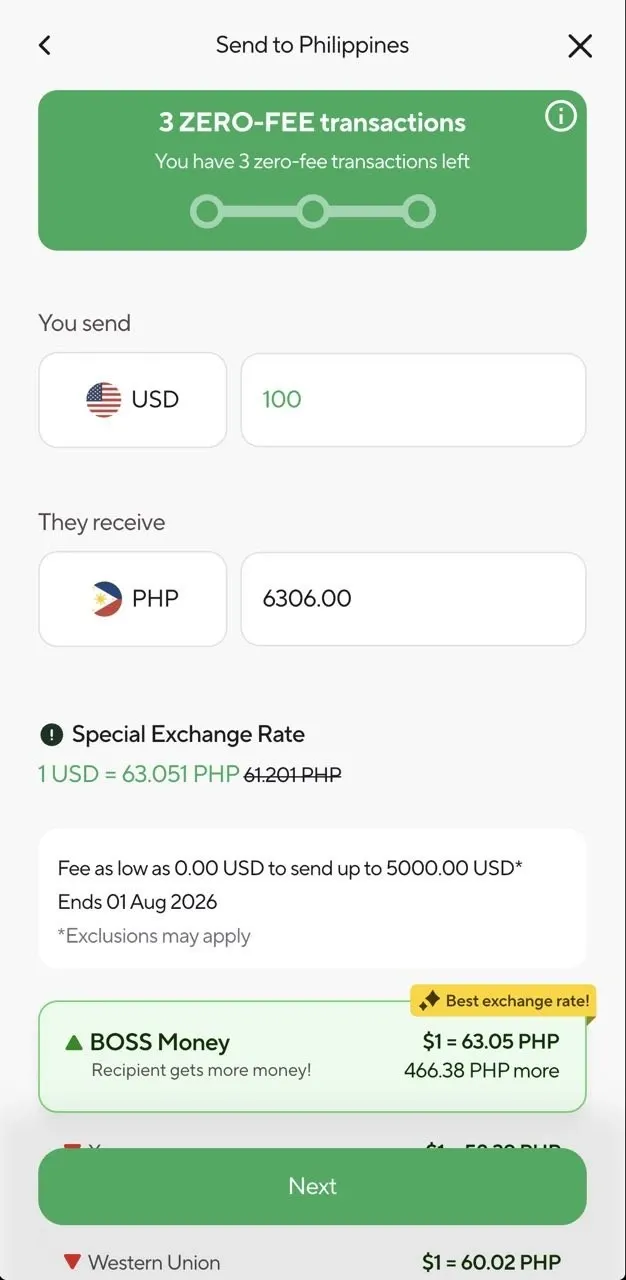
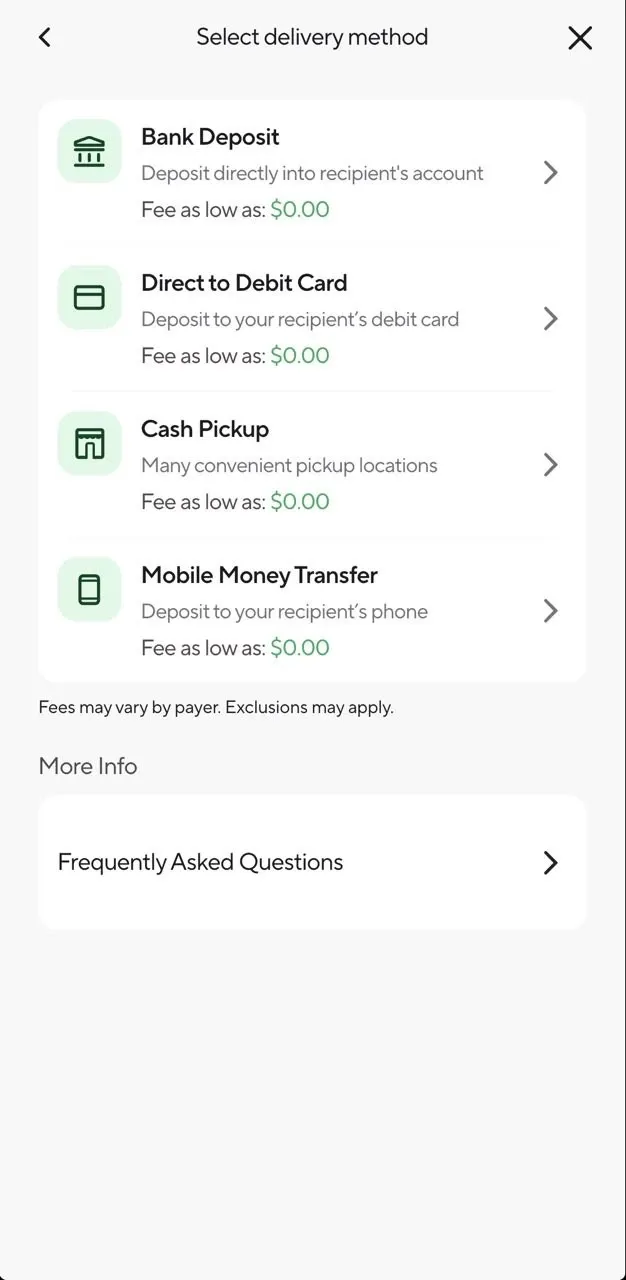
*Screenshots taken as of May 20, 2026 from BOSS Money app - Add recipient: Enter the details carefully. This can be a bank account, a full name for cash pickup, or a wallet number. Even small mistakes can delay the transfer.
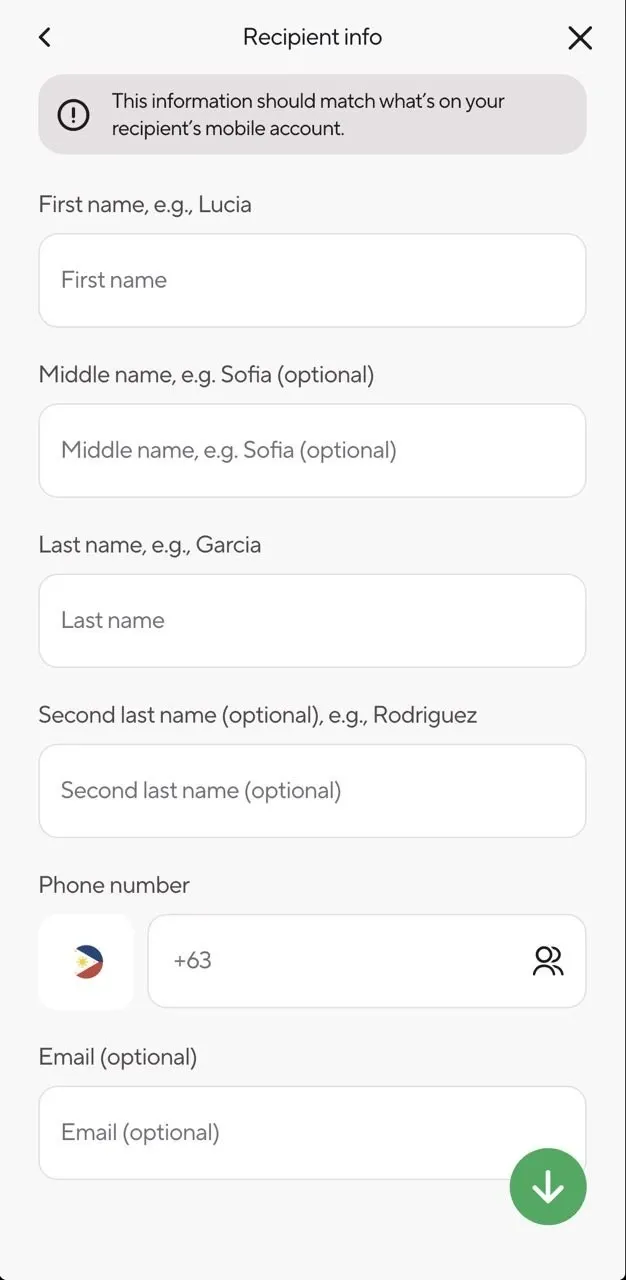
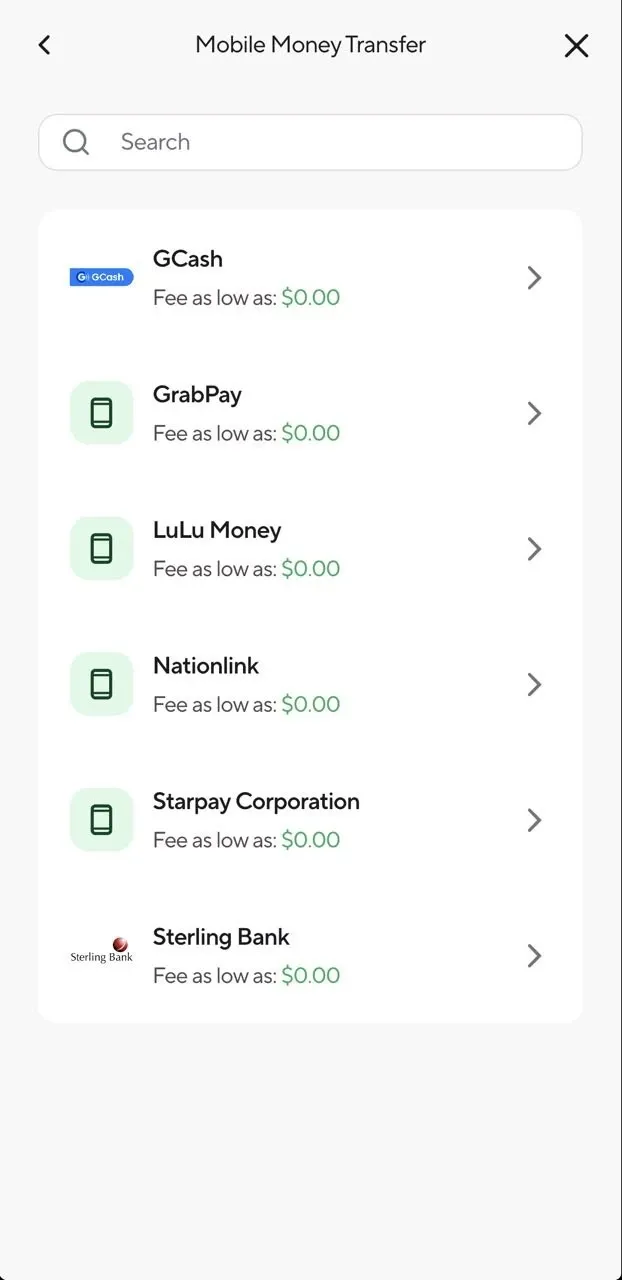
*Screenshots taken as of May 20, 2026 from BOSS Money app
- Choose delivery method: Select how the money will be received. Bank deposits are usually cheaper. Cash pickup is faster. Wallet transfers are often a good middle option.
- Pay: Choose how you want to fund the transfer. Bank payments are cheaper. Debit or credit cards are faster but cost more.
- Track transfer: Most services show updates after you send. You can see when it is processed and when it is ready for pickup or received.
Hidden costs people miss when sending money internationally
Some costs are not obvious at first. They are not always shown upfront, and they usually appear in the final amount the recipient receives.
Following are the ones that matter most.
FX markup
This is built into the exchange rate. You do not always see it as a separate fee. Instead, the provider slightly adjusts the USD to PHP rate. Even a small shift changes the final payout.
Bad exchange rates
Some services advertise low fees but compensate with weaker rates. Over time, small differences add up, especially if you send money regularly.
Credit card fees
If you use a credit card to fund the transfer, extra charges can apply. These may come from the provider or your card issuer.
Intermediary bank fees
Bank transfers sometimes pass through other banks before reaching the Philippines. Each bank in the chain can deduct a fee without warning.
Cancellation issues
Refunds are not always equal to the original amount sent. If exchange rates move, you may receive less back than expected.
Here are some tips to reduce these surprises:
- Always check the final PHP amount, not just the fee
- Compare at least two providers before sending
- Avoid card payments unless speed is necessary
- Review delivery method costs before confirming
Is BOSS Money a good option for sending money to the Philippines?
BOSS Money is usually used as a mid-range option. It is not focused on being the lowest cost service. It is more for people who want a simple way to send money without checking too many details each time.
It works for basic use. You can send money to bank accounts, cash pickup points, and in some cases, mobile wallets like GCash. What is available depends on the transfer route.
One thing people notice is the pricing screen. The cost and exchange rate show up before you confirm. That makes it easier to understand what will arrive on the other side.
*Screenshots taken as of May 20, 2026 from BOSS Money app
The app itself is fairly simple. Once a recipient is saved, sending again takes less time. That is useful if you send money often.
It is not usually the cheapest way to send money to the Philippines, especially for larger amounts. Exchange rates can shift depending on how you pay. Card payments tend to cost more than bank transfers.
Some users still compare it with other apps from time to time. Most end up using BOSS Money because of better rates when they want something that just works with minimal effort.
What is the cheapest way to send money to the Philippines?
Bank transfer is usually the cheapest. The rate matters more than the fee. What you get in pesos is what counts.
What is the fastest way to send money to the Philippines?
Cash pickup or instant transfer are the fastest. Sometimes it lands in a few minutes. Sometimes it takes a bit longer if it gets checked.
Can I send money to GCash from the USA?
Yes. Several apps have this option now. Just choose GCash in the options when you are sending.
How long do transfers to the Philippines take?
It could take anywhere from a few minutes to a couple of days. Card transfers are faster, while bank transfers are slower.
What information do I need to send money internationally?
Typically, you need the name of the person and their bank or wallet details. If any additional information is needed, it is usually mentioned.
Is PayPal a good option for sending money to Philippines?
PayPal works, but it is usually more expensive. The rates are not good, and it is more typically used for shopping online.
Can Zelle send money to Phillippines?
No. It only works inside the US.
Which app has the best exchange rate for PHP?
The ones closest to the real USD to PHP rate have the best rates. The rates change often, so always check before you send.
Conclusion
There is no single best answer here. The best money transfer to the Philippines depends on what you need at the time. If you care about cost, look at the final amount received. Not the fee. If you care about speed, expect to pay more.
Most people end up using apps because they are easier to compare and usually offer better value than banks.
In the end, the best way to transfer money to Philippines is the one that fits your situation. Compare, check the final amount, and then decide.
If you want something that balances cost, speed, and ease of use, BOSS Money is one option to consider.
Sources: all third party information obtained from applicable website as of May 20, 2026
-
https://wise.com/us/send-money/send-money-to-philippines
-
https://www.remitly.com/us/en/philippines
-
https://www.westernunion.com/us/en/send-money-to-philippines.html
-
https://www.moneygram.com/us/en/corridor/philippines
-
https://wise.com/gb/send-money/send-money-to-philippines
-
https://www.remitly.com/
-
https://www.xoom.com/
-
https://www.worldremit.com/en
-
https://www.moneygram.com/us/en
-
https://www.worldremit.com/en/philippines
-
https://www.xoom.com/philippines/send-money
This article is provided for general information purposes only and is not intended to address every aspect of the matters discussed herein. The information in this article is not intended as specific personal advice. The information in this article does not constitute legal, tax, regulatory or other professional advice from IDT Payment Services, Inc. and its affiliates (collectively, “IDT”), and should not be taken or used as such by any individual. IDT makes no representation, warranty or guaranty, whether express or implied, that the content in this article is current, accurate, or complete. You should obtain professional or other substantive advice before taking, or refraining from, any action on the basis of the information in this article.
